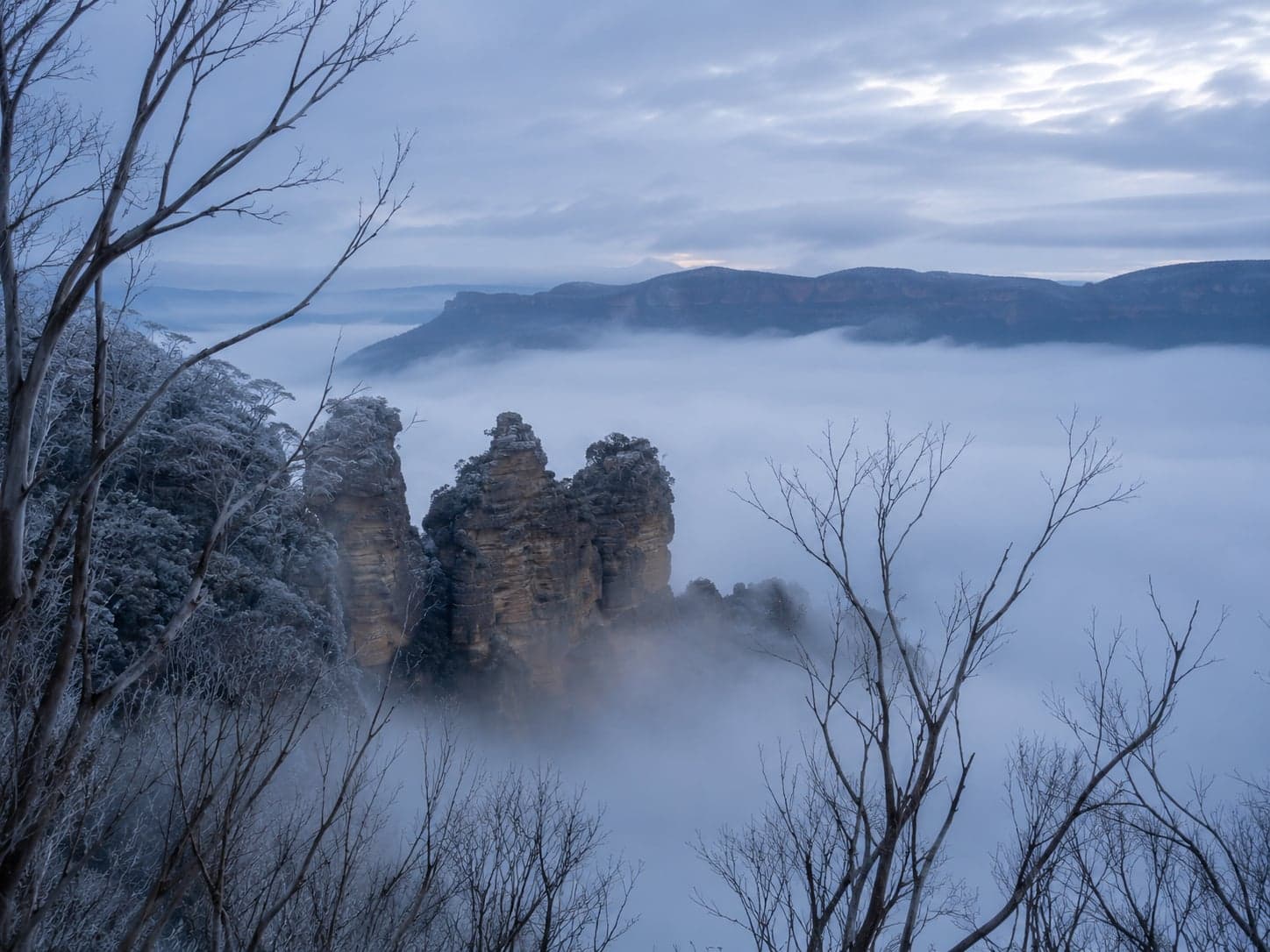
The Blue Mountains in Winter: Why Cold Is the Best Time to Go
Most people visit the Blue Mountains in spring or summer. They queue at Echo Point in warm weather, fight for parking in Katoomba, and share the Giant Stairway with tour groups. June to August is the quieter, sharper, better season. The views are at their clearest, the eucalyptus haze disappears, the waterfalls run fuller after winter rain, and the pubs in Katoomba have lit their fireplaces. Cold mornings are the price of admission. It is worth it.
What winter actually looks like up there
Katoomba sits at around 1,000 metres above sea level and runs 5–7 degrees colder than Sydney at every time of year. In winter, that means typical daytime temperatures of 8–14°C, with mornings that can drop to 2–4°C — occasionally below zero at Blackheath (1,065m), the highest town on the plateau. Frost on the tracks is possible on clear mornings in June and July. Snow happens a few times per decade and shuts the Great Western Highway when it does; it is not something you can plan around, but it is spectacular if it happens.
The blue haze that gives the mountains their name comes from eucalyptus oil droplets scattering light — and it is noticeably reduced in winter's cooler, drier air. The result is clearer views than any other season. The Jamison Valley from Echo Point in June, on a still morning before 9am, is as sharp and detailed as the Blue Mountains ever gets. That view alone is worth the drive.
Why winter beats summer
Crowds are thinner. The school holiday peaks in January and October are the worst times to visit if queues bother you. Midweek in July, Echo Point can be genuinely quiet — a small car park, a handful of walkers, the valley to yourself. Even winter weekends are manageable at the minor lookouts outside Katoomba.
The waterfalls are at their best. Bridal Veil Falls at Govetts Leap in Blackheath drops 180 metres after winter rain — it is the fullest and most dramatic it gets all year. Wentworth Falls runs harder in winter. If waterfalls are part of why you're going, June and July are the right months.
Walking tip
Winter tracks are slippery with frost in the early morning, particularly on the descent tracks like the Giant Stairway and the National Pass. Waterproof shoes with grip are more important in winter than summer. Leave the sandals at WSI.
Where to go: the winter-specific picks
Govetts Leap, Blackheath
The lookout at Govetts Leap is, in my opinion, a better view than Echo Point — the Grose Valley is wider, deeper, and much less photographed. In winter, with Bridal Veil Falls running at full volume after June rains, it is exceptional. The lookout is 600 metres from the car park. From here, the Pulpit Rock track (4km return) follows the cliff edge north with uninterrupted valley views. Blackheath has noticeably fewer tourists than Katoomba and a quieter, more local character.
Wentworth Falls National Pass
The National Pass is a cliff-hugging track that starts at the Conservation Hut in Wentworth Falls village and runs along the valley wall — 5.4 kilometres return, two to three hours, with views of the 187-metre falls from below and alongside. This track is physically demanding and the cliff sections require concentration, but it is one of the best walks in the Blue Mountains and dramatically less crowded than the Echo Point area. In summer it's sweaty and exposed. In winter on a clear morning, the rock is dry, the air is cool, and the valley is at its sharpest.
Echo Point
Still worth it in winter, just arrive early. Before 9am, the car park is nearly empty and the light on the Three Sisters is at its most interesting — low angle, long shadows on the sandstone. The tour buses start arriving from 10am. The Giant Stairway descent (800 steps to the valley floor) is manageable in winter; take your time on the way down and allow two hours for the loop return via the Federal Pass.
Jenolan Caves
An hour south of Katoomba on a winding but scenic road, Jenolan is a serious cave system — nine show caves open for guided tours, plus a heritage guesthouse that has operated since 1880. The caves maintain a constant 12°C all year, which makes them actually warmer than a July morning outside. Book a tour in advance; the Lucas Cave tour is the best introduction. This is a full-day addition to a Blue Mountains trip or a worthy destination on its own.
Fireplace pubs and warming cafes
The Carrington Hotel on Katoomba Street is the right post-walk destination in winter. Open fires, a long bar, pub food that does the job. It has operated continuously since 1882 and the interior reflects that — exposed timber, high ceilings, a heritage feel that the newer venues cannot replicate. Order a bowl of soup and stay longer than you planned.
The Hydro Majestic Hotel at Medlow Bath — halfway between Katoomba and Blackheath — serves afternoon tea in a 1904 heritage hotel with valley views from the dining room. It is more formal and more expensive than the pub options, but the setting is genuinely impressive. Book ahead; it fills on weekends.
In Katoomba: Station Bar and Woodfired Pizza on Katoomba Street does reliable wood-fired pizza and has a warm, busy atmosphere on winter evenings. The Yellow Deli on the same street is reliable for soup and bread. In Blackheath, Ashcroft's on the main street is the local bakery — pies and pastries from morning, cash preferred.
What to pack
- →Warm base layer plus fleece or down jacket — mornings are genuinely cold
- →Waterproof outer shell — rain is possible any month, more likely June and July
- →Walking shoes with grip — frost on tracks in the early morning
- →Thermos with something hot — the lookout benches are cold and the views are long
- →Sun protection — UV is still present on clear winter days at 1,000m
- →Water — 1 litre per person minimum for any walk over 30 minutes
Getting there from WSI
Hire car is the only practical option from WSI before the Metro opens in 2027. Exit via the M12 Motorway, join the M7 heading north-east, take the M4 motorway west through Parramatta and Penrith, then follow the Great Western Highway through Glenbrook to Katoomba. Total distance is around 80 kilometres — allow 50–65 minutes in normal traffic, longer in school holiday periods. Leave before 8am to arrive at Echo Point before the tour buses and in the best morning light.